Being an Ally Is a Verb: What Trans Allyship Actually Looks Like
Being an ally to transgender, nonbinary, and gender-diverse people is not a title you give yourself. It’s something demonstrated through your actions.
You do not need to understand every aspect of gender, know every LGBTQ+ term, or have all the right answers before you can support trans people. You do need to be willing to listen, learn, respect boundaries, correct yourself when you make mistakes, and continue showing up.
Allyship is not about being perfect. It’s about making a consistent effort to create a world where transgender and gender-diverse people are treated with dignity and respect!
For people who are new to transgender topics, knowing where to begin can sometimes feel overwhelming. This guide covers some of the basics every ally should understand, and, more importantly, how to put them into practice~
Start With the Basics: What Does Transgender Mean?
"Transgender," often shortened to "trans," is an umbrella term generally used for people whose gender is different from the sex they were assigned at birth.
For example, a transgender man is a man who was assigned female at birth. A transgender woman is a woman who was assigned male at birth.
Some people identify outside of the categories of exclusively male or female. They may describe themselves as nonbinary, genderfluid, agender, genderqueer, or another identity that better describes their experience.
Some nonbinary people consider themselves transgender, while others do not. There is no requirement that someone use the trans label simply because their gender differs from what they were assigned at birth.
Terminology is a huge first step in better understanding and supporting the trans people in your life. Learning the language surrounding gender identity can help you communicate more respectfully, recognize the many different experiences within our community, and build a stronger foundation for allyship.
Want to learn more? Check out our in-depth Terminology Education post for a deeper look at common terms, identities, and language you may encounter while learning about the trans+ community.
There is enormous diversity within the trans community. There is no single way to look transgender, experience gender, or transition. That is one of the first important lessons of allyship: trans people are individuals, not a checklist.
There Is More Than One Way to Be Trans
One of the easiest mistakes allies can make is developing an idea of what a "real" transgender person is supposed to look like.
There isn't one.
Every trans experience is unique to the individual. There is no single path, timeline, or “right” way to be trans. Every person has their own journey and may have different feelings, experiences, needs, goals, and desires for themselves and their transition. What someone chooses to do, does not do, has access to, receives, or wants can look completely different from another trans person’s experience. No two trans journeys are exactly alike, and none are more or less valid because of those differences.
Some take hormone replacement therapy, commonly called HRT. Some pursue surgeries. Some change their legal name or gender marker. Some change their clothing, hairstyle, voice, or presentation.
However, others may do some, none, or all of those things.
Someone may want medical transition but be unable to access it because of cost, healthcare availability, disability, insurance coverage, family circumstances, safety, discrimination, or where they live. Others simply do not want medical intervention.
None of these choices make someone more or less transgender.
This is especially important to remember because not every trans person will—or wants to—“pass.” There are many reasons someone may not be able to present themselves in the way they want, or in a way that society might immediately associate with their gender identity.
Especially in places like Idaho, some trans people may choose or need to present as the gender they were assigned at birth while at work, around family, in certain public spaces, or in other environments where they do not feel comfortable or safe being out. Someone may use different clothing, a different name, or different pronouns in certain spaces for their own safety. None of that makes them any less trans.
Other trans and gender-diverse people simply do not want to conform to traditional gender roles or expectations. A trans man does not have to dress masculinely to be a man. A trans woman does not have to be feminine to be a woman. A nonbinary person does not owe anyone androgyny. Gender expression does not determine gender identity.
You also cannot reliably determine someone's pronouns simply by looking at them. Use the name and pronouns someone has told you are correct whenever it is safe to do so. If someone has told you they need different names or pronouns used in particular environments for their safety or privacy, respect those boundaries as well.
Allyship means respecting someone's identity based on what they tell you about themselves, not whether their appearance meets society's expectations of what their gender is “supposed” to look like.
Transition is deeply individual. There is no finish line someone has to cross before their gender deserves to be respected.
Names Matter
Using someone's chosen name is one of the simplest and most meaningful forms of respect.
For many transgender people, changing their name can be an important part of transition. Their previous name may no longer represent who they are, and hearing it can sometimes be uncomfortable, distressing, or even unsafe.
It is common in trans+ spaces to use the term “deadname” to refer to a name that someone no longer uses. This is often the name a person was given at birth, but that is not always the case. Someone may have changed their name more than once, or stopped using a particular name for any number of personal reasons.
Not every trans person uses the word “deadname” to describe their previous name, either. Some may simply call it their old, previous, former, or legal name. As with many parts of the trans experience, the best practice is to follow the language that person uses for themselves.

Knowing someone's deadname or previous name does not give you permission to use or share it. In most situations, the name someone currently gives you is the only name you need to know.
You generally do not need to say:
"They used to be named..."
"I knew her when she was..."
"His legal name is actually..."
Unless the person has specifically given you permission to share that information, their previous name is their private information.
This also applies when talking about someone's past.
If someone named Alex uses he/him pronouns today, you generally refer to Alex as Alex and use he/him pronouns even when discussing something that happened before he transitioned.
Artist: wowlar
Instead of: “When Alex was a kid, she loved playing soccer with her friends.”
Say: “When Alex was a kid, he loved playing soccer with his friends.”
Even if Alex used a different name or pronouns at that point in his life, you generally use his current name and pronouns when talking about his past, unless Alex has specifically told you otherwise.
You do not need to rewrite someone's identity every time you talk about their history.
Their Current Name Is Their Real Name
Avoid asking someone for their "real name" when you mean their previous or legal name.
The name someone tells you is their real name.
There may occasionally be administrative circumstances where a legal name is required, such as certain medical, financial, employment, or government documents. Even then, organizations can take steps to protect privacy and use someone's chosen name whenever possible.
Legal paperwork does not determine whether someone's identity is legitimate.
Pronouns Are Basic Respect
Pronouns are words we use when referring to someone without repeatedly using their name.
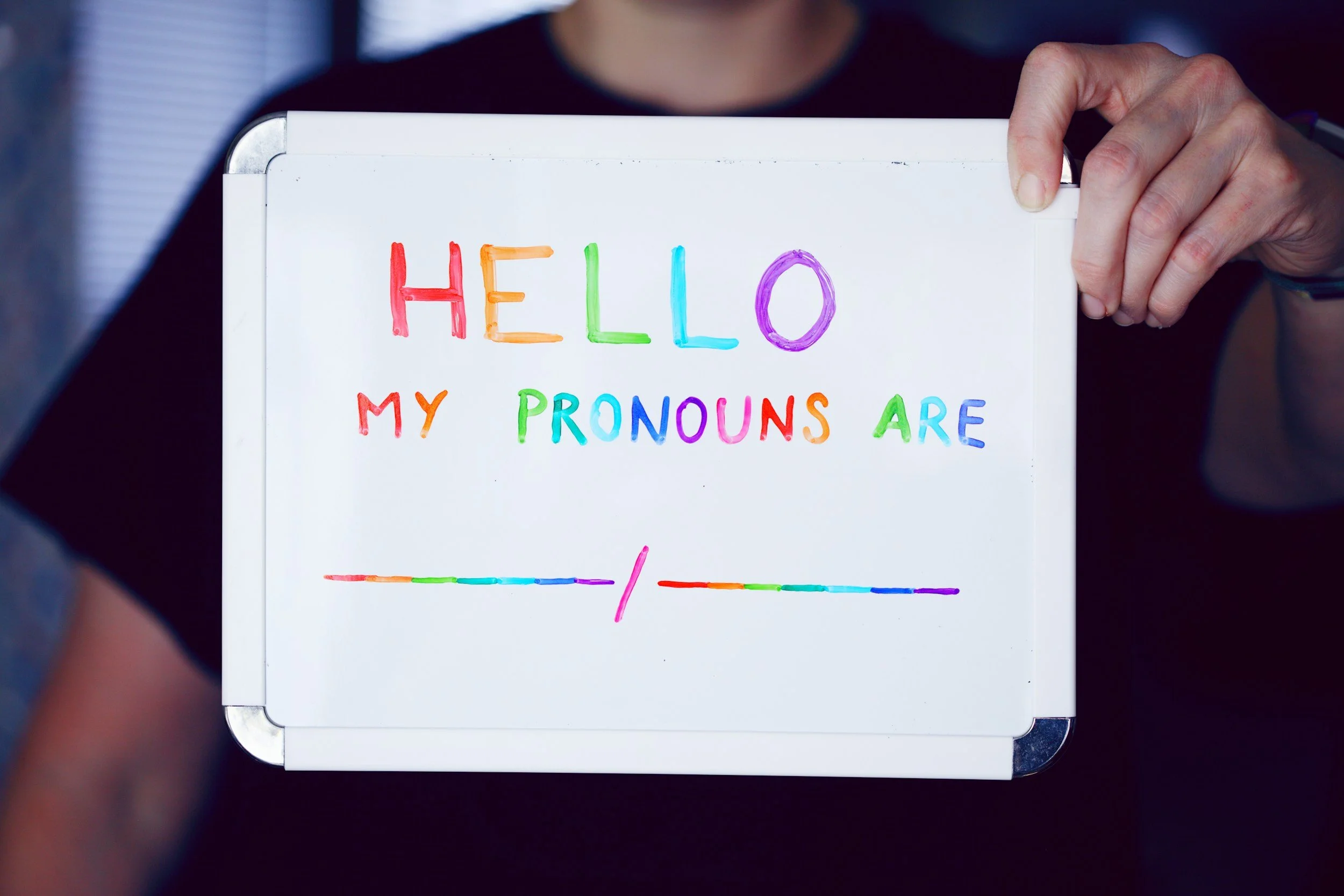
Examples include:
she/her— “She is coming to the meeting. I saved a seat for her."
he/him— "He volunteered yesterday. I worked with him."
they/them— "They are coming to the meeting. I saved a seat for them.”
it/its — “It is coming to the meeting. I saved a seat for it.” Some people intentionally use it/its pronouns for themselves; these should only be used for someone who has specifically said those are their pronouns.xe/xem — “Xe is coming to the meeting. I saved a seat for xem.”
she/they — “She is coming to the meeting. I saved a seat for them.”
he/they — “He is coming to the meeting. I saved a seat for them.”
they/she — “They are coming to the meeting. I saved a seat for her.”
they/he — “They are coming to the meeting. I saved a seat for him.”
any pronouns — “She is coming to the meeting. I saved a seat for them.” (The person is comfortable with any pronouns.)
no pronouns / name only — “Alex is coming to the meeting. I saved a seat for Alex.”
fae/faer — “Fae is coming to the meeting. I saved a seat for faer.”
ze/hir — “Ze is coming to the meeting. I saved a seat for hir.”
ze/zir — “Ze is coming to the meeting. I saved a seat for zir.”
ey/em — “Ey is coming to the meeting. I saved a seat for em.”
e/em — “E is coming to the meeting. I saved a seat for em.”
Some people use multiple sets of pronouns, such as she/they or he/they. Others may use neopronouns or different pronouns altogether.
You do not have to fully understand someone's relationship with gender to use the pronouns they have asked you to use.
Using someone's pronouns is similar to using their correct name. It is a basic way of acknowledging who they are.
What If You Don't Know Someone's Pronouns?
If you genuinely need to know, it is usually okay to ask respectfully.
One easy approach is to introduce yourself with your own pronouns first:
"Hi, I'm Jordan. I use she/her pronouns. What pronouns do you use?"
You can also simply ask:
"What pronouns do you use?"
Try not to frame the question as:
"What are your preferred pronouns?"
For most people, pronouns are not simply a preference. "What pronouns do you use?" is straightforward and respectful.
It is also important not to single out the one person you think might be transgender. If introductions include pronouns, consider making that an option available to everyone rather than only asking people whose gender presentation you perceive as different.
What Happens If You Misgender Someone?
You probably will make a mistake at some point. Even trans folks have done it to other trans folks.
Misgendering means referring to someone using language that does not correctly reflect their gender, such as using the wrong pronouns or gendered terms.
The best response to an accidental mistake is usually simple:
Correct yourself and continue.
For example:
"She—sorry, he—said he would be here at five."
You generally do not need to stop the conversation and provide a lengthy apology.
A response like:
"Oh my God, I'm so sorry! I feel terrible. I'm trying so hard. Please don't be mad at me!"
may be well-intentioned, but it can unintentionally put the transgender person in the position of reassuring you and makes the conversation uncomfortable.
Now they may feel obligated to say:
"It's okay! Don't worry!"
The mistake becomes about the ally's feelings rather than the person who was misgendered.
A simple correction communicates something important: I noticed the mistake, I know the correct language, and I'm going to keep trying.
The same goes for their name as well.
If you repeatedly struggle with someone's pronouns, practice when they aren't around.
Say sentences about them in your head. Write their name alongside their pronouns. Intentionally use their pronouns when talking about them.
Practice makes new language become natural.
What If Someone Else Misgenders a Trans Person?
Allies can also help take some of the burden of correction away from transgender people.
If someone says:
"She said she'd meet us here."
You might simply respond:
"Yeah, he said he'd be here around six."
Sometimes that small correction is enough.
If necessary, you can be more direct:
"Just a reminder, Jordan uses he/him pronouns."
The goal does not need to be embarrassing or publicly shaming someone. The goal is correcting the language and moving forward.
This is especially important because transgender people should not always have to be the only people defending their own names and pronouns.
Allyship means helping establish respectful expectations even when a trans person is not the one doing the correcting.
Words Change—and That's Okay
Language surrounding gender has changed significantly over time and will continue to change.
Terms such as transgender, trans, nonbinary, genderfluid, agender, genderqueer, Two-Spirit, and many others may come up when learning about gender-diverse communities.
You do not need to memorize an entire dictionary before interacting with transgender people.
What matters is being willing to learn.
If someone uses a term you do not recognize, you can look it up through reputable LGBTQ+ educational resources. If knowing the meaning is important to your relationship or conversation, you can also respectfully ask what that term means to the individual. However, remember it is not their responsibility to teach you.
Remember that people may define or experience the same identity somewhat differently.
Labels are tools people use to describe themselves. They are not boxes that allow us to make assumptions about everything else in their lives.
Language Allies Should Be Careful With
Language changes over time, and context matters. However, there are several habits allies can generally avoid.
Avoid referring to transgender people as "transgenders."
"Transgender" is generally used as an adjective.
For example:
"transgender people"
"a transgender woman"
"a trans person"
Similarly, phrases such as "a transgender" reduce a person to a single characteristic.
Terms such as "biologically male" or "biologically female" are also often used in ways that oversimplify both biology and transgender people's experiences. If someone's sex assigned at birth is genuinely relevant, "assigned male at birth" (AMAB) or "assigned female at birth" (AFAB) may be more appropriate depending on the context.
However, you usually do not need to mention someone's assigned sex at all.
Another term allies should understand is cisgender, often shortened to cis.
Cisgender generally describes someone whose gender aligns with the sex they were assigned at birth.
"Transgender" and "cisgender" are descriptive terms. "Cis" is not an insult or slur.
Reclaimed Language and Slurs
Some words historically used as slurs against trans and LGBTQ+ people have been reclaimed by members of those communities. However, reclamation does not mean everyone is comfortable with the word, or that everyone has permission to use it.
For example, some trans people reclaim “tranny,” while many others still experience it as a deeply offensive slur. “Transsexual” is an older medical and identity term that some trans people still proudly use for themselves, while others consider it outdated or do not identify with it.
The important distinction is between someone choosing a word for themselves and someone else assigning that word to them. One person's comfort with a reclaimed term does not mean another person shares it. As an ally, follow the language people use for themselves, and when you're unsure, stick with respectful terms such as trans or transgender.
Don't Ask Questions You Wouldn't Ask a Cisgender Person
Curiosity is understandable, but being curious about someone's body does not create an obligation for them to answer.
Questions about a transgender person's genitals, surgeries, sex life, reproductive organs, or medical treatment are usually inappropriate unless there is a legitimate reason for that information to be discussed.
Before asking a personal question, consider:
Would I ask a cisgender person I just met this same question?
If the answer is no, reconsider asking it.
Questions such as:
"Have you had the surgery?"
"What do you have down there?"
"Are you planning to get surgery?"
"How do you have sex?"
"What was your real name?"
are deeply personal.
A person's transgender identity does not make their body public information. Google is free, use it!
Never Out Someone Without Permission
To "out" someone means revealing that they are transgender or LGBTQ+ without their permission.
Someone being openly transgender around you does not necessarily mean they are openly transgender everywhere.
They may be out to friends but not coworkers.
They may be out online but not to family.
They may be out at an LGBTQ+ event but not at school.
They may use different names or pronouns in environments where being openly transgender could put them at risk.
Do not assume that because you know someone's identity, everyone else is allowed to know it too.
When in doubt, ask privately:
"What name and pronouns should I use around your family?"
"Are you comfortable with me mentioning that you're trans?"
Protecting someone's privacy can also be a matter of protecting their safety, especially in places like Idaho.
You Don't Have to Understand Someone's Gender to Respect Them
This may be one of the most important principles for new allies.
You may encounter an identity you have never heard of.
You may not understand why someone uses certain pronouns.
You may have questions about gender that you are still working through.
Respect does not have to wait until you understand everything.
If someone tells you their name, use it.
If someone tells you their pronouns, make an effort to use them.
If someone tells you how they identify, believe that they understand themselves better than you do.
You do not need to personally experience someone's identity for their experience to be real.
Allyship Means Learning Without Expecting Trans People to Teach You Everything
Transgender people are often expected to become educators simply because they are trans.
One person may regularly receive questions about pronouns, healthcare, surgery, legislation, relationships, bathrooms, sports, childhood, terminology, and countless other subjects.
It can become exhausting.

There is nothing wrong with respectfully asking questions when someone has indicated they are comfortable discussing something. But allies should also take responsibility for their own education.
There are LGBTQ+ organizations, books, research, educational websites, community trainings, and resources specifically created to answer these questions.
Learning independently means the transgender people in your life can simply exist around you without constantly being expected to explain their existence.
Allyship Also Happens When No Trans People Are Around
It is relatively easy to say you support transgender people when you're standing in a room full of them.
Allyship becomes particularly meaningful when a transgender person isn't there to see it.
What happens when a family member makes a transphobic joke?
What happens when someone intentionally misgenders a coworker after they leave the room?
What happens when a friend shares misinformation about transgender healthcare?
What happens when someone says, "Nobody here cares if I say it"?
Those moments matter.
You do not need to turn every situation into a confrontation. Sometimes allyship looks as simple as:
"That's not something I'm comfortable joking about."
"Actually, they use they/them pronouns."
"I don't think that's accurate."
"I don't agree with talking about them that way."
Small interventions can change what behavior people believe will be accepted in a space.
Pride Flags and Pronouns Aren't the Finish Line
Putting a transgender Pride flag in a window can communicate support.
Adding pronouns to an email signature can help normalize sharing them.
Posting about Transgender Day of Visibility can help increase awareness.
Those things can be valuable.
But symbols become much more meaningful when they are supported by action.
If a workplace displays a Pride flag but allows employees to repeatedly harass a transgender coworker, the flag does not make that workplace affirming.
If an organization posts about supporting transgender people but its forms only allow "male" and "female" when other options could reasonably be provided, there is more work to do.
If someone shares supportive graphics online but remains silent when their friends make transphobic comments, there is more work to do.
Allyship should extend beyond what other people can see.
You Will Make Mistakes
Every ally will eventually say the wrong thing, misunderstand something, use outdated terminology, or discover that something they previously believed was incorrect.
The question isn't whether you will ever make a mistake. The question is what you do afterward!!
Listen.
Correct yourself.
Apologize when appropriate.
Learn.
Change the behavior.
Then continue.
Being corrected does not automatically mean someone thinks you are a terrible person. Sometimes it simply means you were given information you did not previously have, take that with grace.
You can choose what you do with it.
Ally Is Something You Practice
There is no certificate that means you have officially completed allyship. It’s also something you should consider before you call yourself such.
Communities change. Language evolves. New issues arise. And different transgender people will have different experiences, needs, boundaries, and opinions.
Being an ally means remaining willing to learn.
It means respecting someone's name when they're standing beside you and when they're not.
It means using someone's pronouns even if they aren't there to hear you.
It means protecting someone's privacy.
It means recognizing when curiosity crosses a boundary.
It means correcting misinformation.
It means listening when transgender people describe their experiences.
It means understanding that transgender people do not owe you their medical histories, previous names, bodies, personal stories, or explanations.
And sometimes it means recognizing that the most helpful thing you can do is simply treat a transgender person like any other human being.
You don't need to know everything to begin.
You just need to be willing to keep learning, and to turn what you learn into action!
Key Takeaways: Putting Allyship Into Practice
Here are some of the most important things to remember:
Use the name and pronouns someone gives you. You do not need to understand their gender completely to respect it.
If you make a mistake, correct yourself and move forward. A brief correction is usually more helpful than a lengthy apology.
Don't out someone without their permission. Knowing that someone is transgender does not give you permission to share that information.
Respect people's privacy. Trans people do not owe anyone information about their bodies, surgeries, medications, previous names, or sex lives.
Don't assume what transition should look like. Some people medically transition, some socially transition, some do both, and some do neither.
Gender identity, gender expression, and sexual orientation are different. How someone dresses, who they date, and what their gender is are separate things.
Take responsibility for your own education. Trans people should not have to constantly explain transgender identities or issues to the people around them.
Speak up even when trans people aren't in the room. Correcting misinformation, misgendering, jokes, and disrespect shouldn't always fall on transgender people.
Support needs to go beyond symbols. Pride flags, pronouns in bios, and supportive posts are valuable, but policies, behavior, advocacy, and everyday actions matter too.
Expect to keep learning. Language changes, communities evolve, and you will sometimes make mistakes. What matters is how you respond and whether you change your behavior.
Listen to trans people as individuals. No single transgender person represents the entire community, and different people may have different needs, boundaries, and experiences.
Remember that allyship is an ongoing practice. Being an ally isn't something you declare once. It is something demonstrated through the choices you make every day.
At its core, allyship can be remarkably simple: respect people's identities, protect their dignity, listen when they tell you what they need, keep educating yourself, and be willing to act when it matters.